
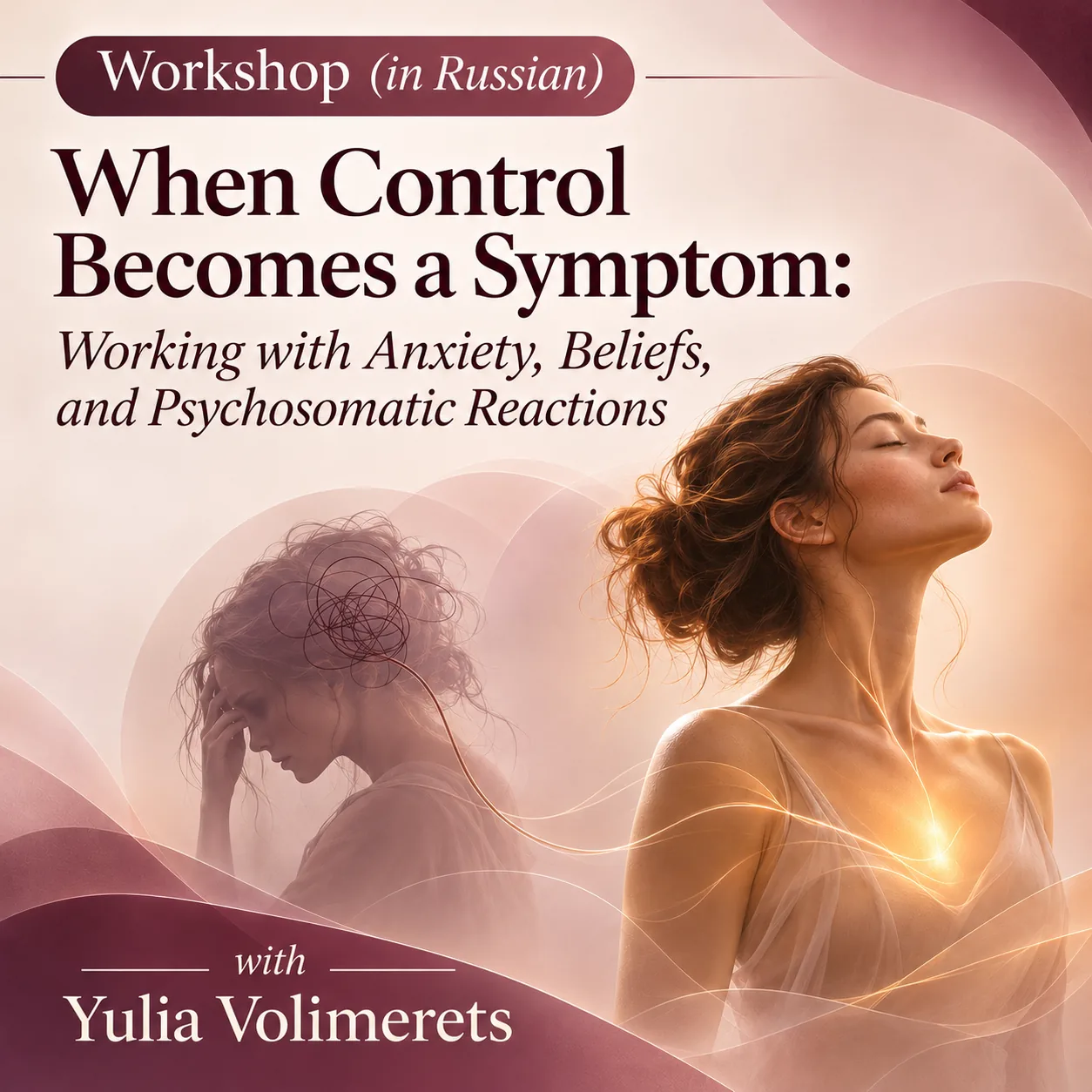
Control, Fear and the Body: Psychosomatic Symptoms Workshop
Discover our psychosomatic symptoms workshop in Russian with Yulia Volimerets. Explore how anxiety, excessive control, and limiting beliefs can influence physical symptoms, and learn how CBT and clinical hypnosis can be integrated into professional practice.
Professional Workshop with Yulia Volimerets | Conducted in Russian
When Control Becomes a Source of Anxiety
Why do some people experience more anxiety and physical tension the harder they try to stay in control?
For many clients, excessive control becomes a psychological safety strategy. Constant monitoring, repeated checking, and attempts to eliminate uncertainty may temporarily reduce anxiety while reinforcing patterns of fear, hypervigilance, and physical discomfort.
This professional workshop explores the connection between fear of losing control, anxiety, cognitive beliefs, and psychosomatic reactions through an integrative psychological framework.
Led by Yulia Volimerets, the workshop combines Cognitive Behavioral Therapy (CBT), hypnosis, coaching-based inquiry, and metaphorical associative cards (MAC).
Psychosomatic Symptoms Workshop: What You Will Learn
1. Understanding the Control-Anxiety-Symptom Cycle
Explore how perceived threats, excessive self-monitoring, and protective behaviors can contribute to a self-reinforcing cycle of anxiety and physiological arousal.
- Identify the relationship between uncertainty, fear, and excessive control.
- Understand how threat interpretations influence emotional and physical responses.
- Recognize checking and avoidance behaviors that may maintain anxiety.
2. Exploring Control Through Metaphorical Associative Cards (MAC)
Discover how metaphorical images can support structured conversations about control, perceived safety, and personal beliefs.
- Use reflective questions to explore the client’s relationship with control.
- Identify fears associated with uncertainty.
- Explore the protective function of control-related behaviors.
- Translate personal metaphors into a working psychological formulation.
3. Identifying Control-Related Beliefs with CBT
Examine how rigid beliefs may contribute to anxiety and excessive self-monitoring.
Examples of common beliefs:
- “If I lose control, something bad will happen.”
- “I must always be prepared.”
- “Relaxing means becoming vulnerable.”
- “My safety depends on controlling everything.”
Learn how cognitive restructuring and behavioral experiments can help clients develop more flexible responses to uncertainty.
4. Integrating Hypnosis into Therapeutic Work
Explore how hypnotic imagery, therapeutic suggestions, and future-oriented mental rehearsal may complement cognitive and behavioral interventions.
- Develop alternative responses to anxiety-provoking situations.
- Use hypnotic rehearsal to support flexible self-regulation.
- Reinforce personally meaningful alternative beliefs.
- Connect new cognitive perspectives with practical behavioral changes.
A Practical Integrative Framework
The workshop introduces a structured approach:
Metaphorical Exploration → Cognitive Formulation → Protective Function → Hypnotic Integration → Behavioral Reinforcement
The goal is not to eliminate control, but to help clients distinguish between productive self-regulation and excessive control strategies that may maintain psychological distress.
Who Should Attend?
This professional workshop is designed for:
- Psychologists and mental health professionals
- Hypnotists and hypnotherapy practitioners
- Professional coaches
- Counseling and psychotherapy students
- Professionals interested in anxiety, mind-body interactions, and integrative psychological approaches
Workshop Information
- Instructor: Yulia Volimerets
- Language: Russian
- Duration: 2.5 hours (150 minutes)
- Format: Professional educational workshop
- Workshop date: November 13, 2026
About the Instructor
Yulia Volimerets is a clinical psychologist, ICF Professional Certified Coach (PCC), NGH Certified Hypnotist & Instructor, and founder of the Chicago Institute of Hypnosis and Coaching.
Her integrative educational approach combines psychological science, cognitive-behavioral principles, professional coaching, and clinical applications of hypnosis.
Explore More Workshops
Interested in additional professional training in hypnosis, cognitive techniques, coaching, and integrative psychological practice?
Explore Workshops with Yulia Volimerets
Educational Disclaimer: This workshop is intended for professional education and skills development. Physical symptoms may have medical causes and require appropriate evaluation. Workshop techniques should be applied within the participant’s professional scope of practice.
